
Cheaper Cocoa, Dearer Chocolate
Three manufacturers met a consumer revolt with smaller packs and came out of it more profitable than they went in.

This spring the chocolate aisle looked like it had broken. Lindt was cutting prices, Hershey’s confectionery margin had fallen hard, Mondelez earnings had halved, and a German court was preparing to rule that a Milka wrapper misled the people who bought it. The obvious reading was discipline: the household had refused, and the sellers were being corrected by the refusal.
Two quarters of results are now in. The refusal was real and it was heard — every earnings call this season names elasticity out loud. What did not happen is the correction.
Hershey’s North American confectionery margin, which bottomed at 21.8% in the third quarter of 2025, printed 32.5% in the quarter ending June — up 830 basis points year-over-year, above where it stood in early 2025, on volume down roughly ten points. Lindt raised prices 11.8% group-wide across the first half, absorbed a 7.5% volume decline, and confirmed full-year guidance. Mondelez raised its outlook.
Every manufacturer in this dispatch is more profitable than it was before the consumer pushed back. That is the finding, and it is not what an elasticity story is supposed to produce.
The Physical Measure
Before the corporate numbers, one that no investor relations department controls.
Cocoa grindings — beans actually processed into liquor, butter and powder — are the closest thing this industry has to a physical demand reading. European grindings fell 4.6% year-over-year in Q2 2026 to 316,366 tonnes, the weakest quarter since 2020. Over the same period, Asia rose 25.1% and North America rose 7.7%.
Europe is processing less cocoa than at any point in five years.
Hold that against what Mondelez told analysts on July 28. COO Luca Zaramella: “The European chocolate business is on a positive volume mix trajectory. Volumes are improving, and we see that continuing through the second half.” The company also flagged an unprecedented Q2 heat wave that suppressed chocolate consumption, and said it held back trade stock to manage inventory.
Both statements can be technically true — a single company’s shipment volumes can improve while an entire continent’s bean processing hits a five-year low, particularly if inventory is being managed across the quarter. But when guidance and physical throughput point in opposite directions, the physical measure is the one with no incentive attached. I would weight the grindings.
Where the Margin Came From
Three mechanisms, running at once. None of them requires the consumer to come back.
The input windfall, not passed through. Cocoa peaked at $12,906 per tonne in December 2024. It traded at $5,112 on July 30 — down roughly 40% year-over-year and about 60% from the high. Retail chocolate did not fall 40%, or anything close. A price level engineered to survive $12,000 cocoa is currently being applied to $5,000 cocoa, and the gap between those two numbers is most of the margin recovery. This is the ordinary asymmetry of consumer pricing, where costs travel up the shelf quickly and down it slowly, but the amplitude this cycle is unusual enough to be the whole story on its own.
The forward view is more comfortable still. Zaramella pointed analysts to a 500,000-tonne surplus and roughly ten months of industry coverage against seven previously, arguing the market is fundamentally elsewhere from the 2024 crisis. Hershey’s CFO guided to cocoa deflation in 2027. Neither company has committed to passing it on.
Shrinkflation, and its refined successor. The word everyone already has for this describes the crude
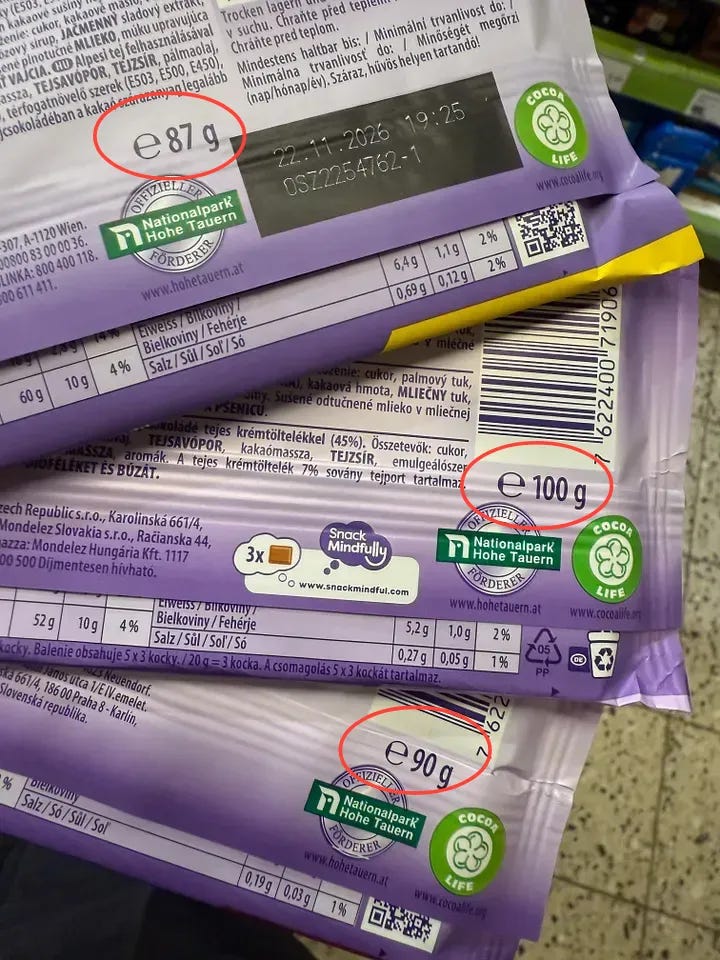
version accurately. Mondelez took the Milka bar from 100g to 90g while the wrapper stayed nearly identical, moving the price from €1.49 to €1.99 — 48% more per kilogram. The Landgericht Bremen (Az. 12 O 118/25) sided with Verbraucherzentrale Hamburg, holding that the recognition effect of the packaging overrode the actual change in content, and that consumers cannot be expected to scrutinise packaging on products they already know. Mondelez has appealed to the Hanseatisches Oberlandesgericht in Bremen; no hearing date is set.
The judgment covers one step. The shelf shows the practice. Three Milka bars photographed together in a Central European supermarket in spring 2026 carry 87g, 90g and 100g, the differences tracking fillings and formats rather than any standard a shopper could hold in mind. Every grammage is printed on the back of every bar.
The refined version needs nobody to be deceived. Lindt’s July disclosure is the clearest statement of method anyone has put on record this year: alongside selective price cuts, the company is introducing new pack sizes — Lindor in 100g and 137g, a 337g pack beside the existing 500g. Its own framing is that the price per kilogram is not meant to come down in any fundamental way, while the amount the customer pays at the till does.
Nothing there is concealed. The smaller pack is a new SKU rather than a shrunken old one, the grammage is printed on the front, and anyone reading the €/kg label sees exactly what is happening. That is also what makes it more durable than the Milka bar: the covert version can be taken to court, and was. A new product line cannot.
Both firms are solving one problem — how to hold €/kg once the household has stopped accepting the shelf price. Lindt solved it with a product line and a press release, Mondelez with a wrapper and, eventually, a judgment. The legal distance between them is real and the Bremen court was right to draw it. The economic distance is much shorter, which is the part shrinkflation as a term tends to obscure: the deception is the litigable surface, not the mechanism.
The customer, sorted. Mondelez management described the consumer as “K-shaped” without prompting: buyers moving to value formats and channels where prices are lower, while premium and better-for-you options simultaneously do well. Value channel growth in North America ran high single digits.
That is a barbell, and it is what the segment data shows. Lindt’s North America grew 12.7% on Lindor and Ghirardelli — the premium shelf — while Hershey’s North American volume fell ten points across a portfolio weighted to mid-tier and seasonal. In Germany, private label reached a record 47% of the grocery market against 41% in 2021, with tablet chocolate among the strongest gainers and the premium private-label tier growing 11%, faster than private label overall.
Both ends of the shelf are growing. What is contracting sits between them.
Why the Middle Is the Casualty
The mid-tier branded good rested on a specific household condition: enough surplus to pay a brand premium routinely, and not enough for the purchase to feel considered. Remove either half and the proposition fails.
New York Fed research published May 1 shows how thoroughly that condition has been removed for part of the population. Since 2023, only households above $125,000 have consistently posted real spending growth; the lowest band declined in real terms and the middle stalled. The companion piece asks why, and rules out the obvious answer: wage growth cannot explain the pattern. Net worth can — real net worth for the top percentile grew over 25% while middle-income households saw under 10%, driven by financial assets rather than earnings.
One finding belongs in this dispatch specifically. The lowest-income households experienced inflation above the national average over this period; the top 20% experienced it at or below. Two households in the same country, reading the same CPI print, did not face the same price level. The classical Cantillon effect describes who receives new money first. This is the same asymmetry expressed as a measurement failure, and it runs in the direction that compounds.
The Fed draws the conclusion itself: the substantial role of financial assets raises questions about the vulnerability of retail spending to a market correction. Read plainly, the half of the American consumer base currently holding up the aggregate is levered to portfolio values rather than paychecks.
What This Does to the Frame
In my book "The Frame I leaned on Hayek: no central mind can hold the knowledge needed to coordinate an economy, because the relevant information is dispersed and carried by prices. Easter 2026 looked like a clean demonstration — tens of millions of households running the same private calculation, arriving at the same answer without coordinating.

The August version is less flattering to the mechanism.
A price is only a measurement if the unit behind it holds still. When the seller controls the denominator, refusing a price and adjusting a quantity are moves on different boards. The household refused in euros per bar. The manufacturer answered in grams, and the household was not counting grams.
The CPI has the same blind spot in institutional form. It measures what people pay for what they buy, not what they stopped buying, and it handles grammage changes late and partially. A category that redenominates its units in the same year its input costs fall 40% will be recorded, in the statistics, as disinflation. In the household it registers as nothing having changed.
That is the part of this worth carrying out of the chocolate aisle. The measurement did not fail because anyone lied. Every number involved is accurate. The unit moved underneath the number, and no institution in the chain is built to notice.
Base Case, Worst Case, Best Case
Base case. Cocoa holds in the $4,500–6,500 band, 2026 hedges roll off, 2027 margins expand further on the deflation both CFOs are now guiding toward. Volume recovers partially in Europe as the saving rate normalises, but from a permanently lower floor and at a permanently higher €/kg — nobody restores a grammage. The K persists in North America: premium grows, mid-tier bleeds volume, aggregate looks adequate. Management guidance (Hershey 3–3.5% organic, Mondelez 2%+, Lindt 4–6%) is consistent with exactly this.
Worst case. The correction arrives through the asset channel the Fed flagged rather than the wage channel. A meaningful drawdown removes the top-percentile spending currently concealing the American mid-tier decline, and the US shelf looks European inside two quarters — quickly, not the way a wage grind would deliver it. Layer on a cocoa surplus that fails to repeat (the July 9 spike to $6,455 was not nothing) and the manufacturers meet a weaker consumer having already spent both the pricing lever and the grammage lever.
Best case. Real wages outrun the price level for several consecutive years, the European saving rate normalises, and the mid-tier recovers its routine purchase without redenomination. Nothing in the current Eurostat series — real income per capita flat in Q1 2026, real consumption flat, saving rate steady at 14.3% — points this way. Possible, but not the modal outcome.
The Case Against This Reading
It is an ordinary commodity cycle described dramatically. Cocoa quadrupled and fell 60%. Manufacturers lagged up and lagged down, and margins are normalising on schedule. Every input shock in the history of consumer staples has produced this sequence, and reaching for the measuring stick to explain it is unnecessary.
The volume numbers are partly mechanical. Hershey attributes its ten-point drop to “price elasticity and normal quarter-to-quarter shipment variability.” Retailer phasing ahead of the Halloween build moves quarters by several points. Lindt’s European weakness is partly reduced Asian and Middle Eastern tourist traffic, which has nothing to do with German household budgets. Mondelez blames a heat wave for European chocolate softness, and heat waves are not monetary events.
The demand story may be pharmacological. GLP-1 adoption is suppressing appetite in precisely the demographics that buy mid-tier confectionery. If that is the driver, the Cantillon framing is a category error in economic dress.
The first objection is the strongest and is partly correct — most of the margin recovery genuinely is cocoa. What none of the three explains is the pack-size decision. A commodity cycle does not require anyone to change the size of the bar. A heat wave does not require holding €/kg constant while lowering the checkout price. A GLP-1 shock does not produce two companies with different portfolios redesigning pack architecture in the same two quarters. That decision is about what the household can perceive, and perception is not a commodity variable.
What to Watch
Two indicators, neither of which appears in a CPI print.
The first is whether pack redenomination crosses the Atlantic. It is a European manoeuvre today, because Europe is where the shelf price stopped working. The quarter it starts appearing on American shelves is the quarter the top percentile stopped covering for everyone below — and since that half is asset-priced, the notice period will be short.
The second is European grindings. Q2 was the weakest since 2020. If Q3 confirms rather than rebounds, management’s “volumes are improving” does not survive contact with the beans.
And one habit, which is the actual deliverable: read €/kg, not €/unit. It is printed on every shelf label in the European Union, it requires no arithmetic, and it is the only number in the aisle that has told the truth for three years running.
The household said no, and was heard, and was agreed with, and was then answered in a unit it had never been counting in.
- Janus
Protocol & Treasury Analyst — writing from Europe, reading worldwide.
Janus runs 1:1 Confrontation — sixty minutes, one decision, no follow-up. For people who carry responsibility and want their thinking taken apart before it costs them.
janusthewatcher.substack.com/p/11-confrontation
One sentence is enough.