
The Mortal God
Part Five of Six in the State of the Republic series: Recognition, the Grievance Economy, and the Death of the Leviathan

This is the generation of that great LEVIATHAN, or rather, to speak more reverently, of that Mortall God, to which we owe, under the Immortall God, our peace and defence.
— Thomas Hobbes, Leviathan, 1651
It does not tyrannise, but it compresses, enervates, extinguishes, and stupefies a people, till each nation is reduced to be nothing better than a flock of timid and industrious animals, of which the government is the shepherd.
— Alexis de Tocqueville, Democracy in America, 1840
The Color of the Paint
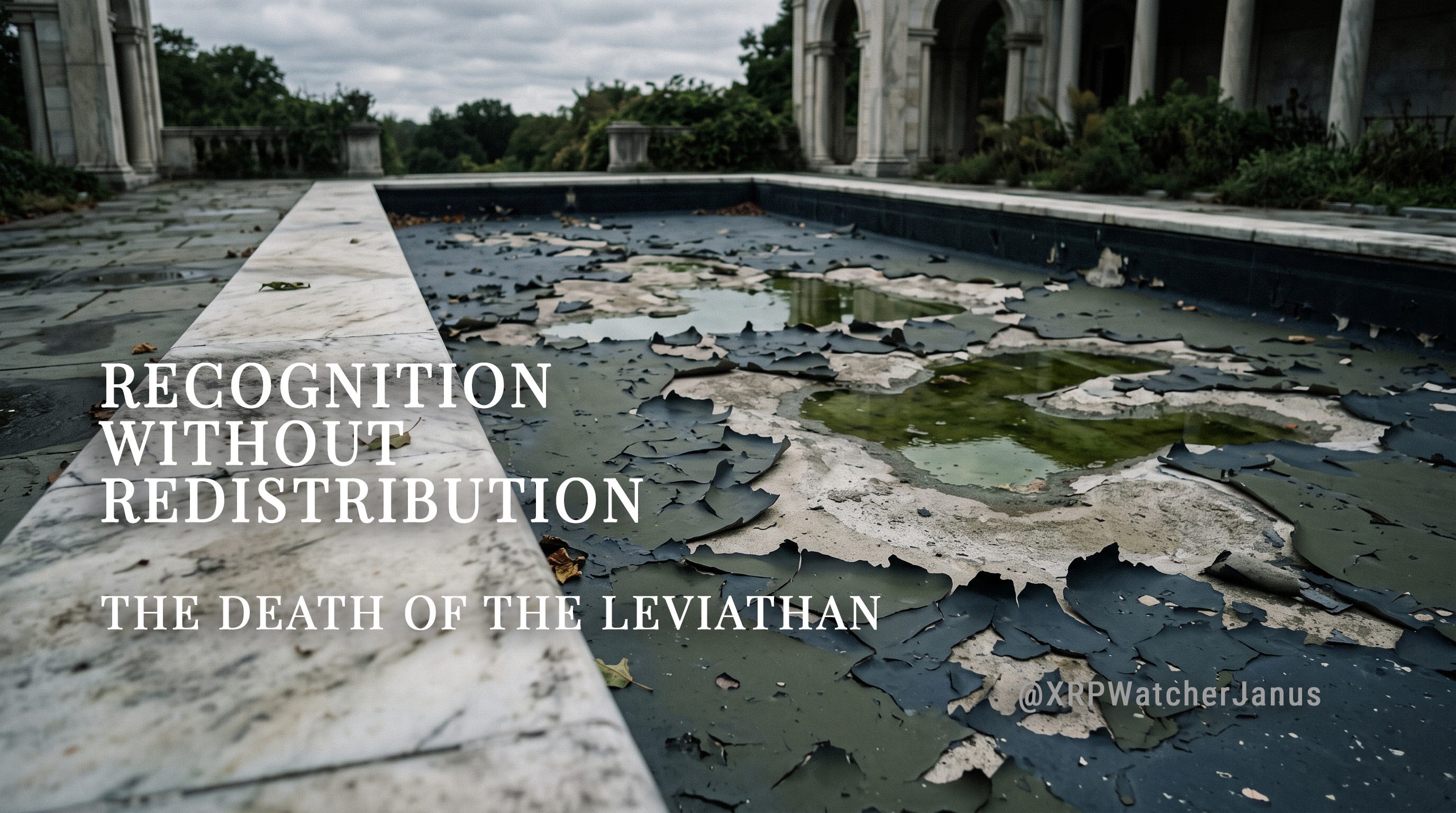
In the weeks before the country’s two-hundred-and-fiftieth anniversary, the administration had the bottom of the Lincoln Memorial Reflecting Pool repainted the color of the American flag. The contract was no-bid, worth nearly fifteen million dollars, and the work was announced as the clearing-away of a predecessor’s filth and incompetence. Within days the water turned green. The dark new surface absorbed more heat than the pale concrete it replaced, the algae bloomed in it, and the crews sent to fix the bloom poured in hydrogen peroxide, which began to lift the paint off the floor of the pool. By the reporting of one outlet the liner itself was coming apart. The Interior spokesperson called the algae residual and blamed reactivated supply lines.
A reflecting pool is a thing that mirrors what is in front of it. It cannot be made to mirror by being painted to mirror. The recognition machine that ordered the job had decided how the pool should look without consulting how the pool worked, and the country walking past it on the Fourth of July would see, before the marble and the obelisk and the dome, the color coming off the bottom. Hold the image. It is the whole argument in one basin of green water: a system that has learned to manage how things appear and lost the capacity to manage how things are.
The Offer That Costs Nothing
Two presidents, one mechanism. Barack Obama made Black Americans feel seen, represented, mirrored at the summit of national life, while the material facts of Black wealth and class held roughly where they had been, and worsened on some measures after 2008. Donald Trump did the same thing in reverse for the white working and middle class: not I will lift you, but I see you, you are the real country, the people who look down on you are the problem. Different constituencies, opposite valence, identical move.
The political theorist Nancy Fraser gave the move its name: the substitution of recognition for redistribution. Recognition is the politics of being seen. Redistribution is the politics of being made materially better off. The first is cheap and bonds the voter to the leader. The second is expensive, risky, and slow. A politics that has learned to deliver the first in place of the second commands loyalty without paying for it, and it does so across the spectrum. The center practices the same substitution in diluted form. What follows describes a mechanism, not a party.
The Architect’s Voice
Does the actor at the center of the mechanism know what he is doing? The mechanism is easier to dismiss if its operation requires the strategic clarity that nobody in politics has. The structure works regardless of what the actor believes. But sometimes the actor says the thing out loud.
On the twelfth of June, 2026, at a White House signing ceremony, the president stood among the people he was nominally honoring, fishermen, gathered to mark a proclamation opening the Pacific Remote Islands to commercial activity, and told them what he believed about the country he ran.
The complainers didn’t build the country. These people built the country, not the complainers. Whether it’s fishermen or farmers or anything else. Me. Guys like me, they built the country. And you know, I watch all these ingrates, they’re always complaining, complaining. They didn’t build anything, they couldn’t build anything.
Read the sentence twice. The fishermen arranged behind him were the pretext; the real address is the conjunction. The country was built, the sentence says, by these people, and then, with a substitution that does not even register as a substitution, by me, guys like me. The conjunction is not and. It is or. The architect-class of the closing clause is a different group from the fishermen of the opening one, the class of wealthy builders to which the speaker assigns himself and the voter does not belong. The voter is not absent from the sentence. The voter is the audience for it, told what the country was built by, and that is the position the recognition machine has prepared him to occupy.
Set the line beside Louis Brandeis’s sentence in his 1928 dissent in Olmstead v. United States. “Our Government,” Brandeis wrote, “is the potent, the omnipresent teacher. For good or for ill, it teaches the whole people by its example.” That is government as common teacher, addressed to all. The signing-room sentence is its inversion: government as personal monument, addressed past the voter to a class that excludes him. Brandeis describes a res publica, a thing held in common. The signing-room sentence describes res mea, a thing held by him.
The line makes a structural property visible. Inclusive recognition, Reagan’s morning in America or Obama’s yes we can, invites the voter into the building; the credit is distributed, the voter cast as co-builder of the thing the leader narrates. Exclusive recognition reserves the credit for the leader and a small class and recasts the voter from co-builder into audience. The two forms look alike on the surface and behave differently over time. The shared form survives the leader, because the voter’s identification with the project does not depend on his continued presence to be retrievable. The exclusive form dies with him, because the voter was never inside the building. It is the only form a single-variable recognition optimizer can produce. The inclusive form requires trade, credit ceded to the voter in exchange for loyalty, and trade is exactly what an undivided recognition function cannot perform.
A second self-inscription arrived two days later. The fourteenth of June was the architect’s eightieth birthday, and the day the United States announced an end to its war with Iran, after a forty-five-day war and the blockade that closed it. The terms were disputed at once: Iranian state media released its own version, and the President called the leak dishonorable and the terms inaccurate. Beneath the dispute sat a structural fact. The deal restored an Iranian pledge never to build a weapon, reopened the Strait of Hormuz against a lifted blockade, and set a sixty-day window to negotiate the rest, an architecture whose nuclear language echoed the agreement the same President had walked away from in 2018, calling it the worst deal ever negotiated.
The echo did not go unremarked, and the remarking happened on his own side’s airtime. The Secretary of War went on Face the Nation to sell the deal and said the document holds that Iran will never have a nuclear weapon. The host interjected four words: “JCPOA said that too.” The Secretary did not contest the textual identity. He answered with a frame. The old deal was a path to a bomb, this one a wall to a bomb, and the difference was that “we did this from a position of strength.” The substance was conceded; the difference asserted in its place was one of leverage and authorship.
Read the two inscriptions together. The signing-room line says the country was built by people like me. The Iran exchange says the document I am signing carries the language I once called the worst deal ever, and the only thing I have left to say about the difference is that this time I am the one who signed it. The recognition machine, having maximized its public claim, accumulates frames, and the frames begin to bind the actor against his own present. He cannot revise the 2018 position; it is on tape. He cannot deny the 2026 substance without abandoning the 2026 announcement. He can only translate, through his apparatus, a difference of frame where a difference of substance would be required. That is not the machine improvising. It is the machine caught between two of its own earlier statements, with no third move available.
A third inscription, older than the other two, surfaced on the sixteenth of June, when a chess grandmaster turned dissident reposted a screenshot of a presidential statement from the sixth of March. One hundred days before the end of the war, the President had written on his own platform that there would be no deal with Iran except unconditional surrender, after which, and the selection of a great and acceptable leader, the United States and its allies would work to bring Iran back from the brink of destruction and make it economically bigger, better, and stronger than ever before. Make Iran Great Again. The dissident attached one sentence: he demanded unconditional surrender, we just didn’t know he meant America’s. The point is not the line, good as it is. The point is the interval. A frame written in March about an enemy that would surrender unconditionally is materially inconsistent with an announcement made in June in which the enemy surrendered nothing and the friend was promised it would be made bigger, better, and stronger than ever before. Both statements are presidential, both are on tape, both are searchable inside thirty seconds by anyone with a phone. In 2018 the President produced a frame that took until 2026 to come back; eight years. In March 2026 he produced one that came back in June; one hundred days. By the signing week the frames were colliding inside the same news cycle. The binding period inside which a public claim stays load-bearing is collapsing, because the machine produces frames faster than its own substrate can absorb them. That is not a malfunction. It is the machine working as designed, meeting the limit of the material it runs on.
The fourth inscription was written by the system rather than the speaker. On the evening of the seventeenth of June the architect signed the memorandum inside the Palace of Versailles, during a dinner hosted by the President of France. The Vice President, the negotiator both governments had designated as the American signatory, was not in the room. By the morning of the nineteenth, thirty-six hours later, the Swiss foreign ministry cancelled the first negotiating session at Bürgenstock before it could begin; the Vice President did not fly, the deal’s Pakistani mediator did not fly, and the reason given was Tehran’s complaint about continued Israeli strikes in Lebanon. Clause one of the document, the most fragile to sabotage, had been violated before the ink dried, and the violation pushed the deferred provisions, the ones tied to the nuclear question, into exactly the limbo a Paris-based analyst had named the day before: the United States no longer had the leverage to extract better terms after showing it could not extract them on the battlefield. Thirty-six hours later the limbo was on the official schedule.
The room itself carried a substance the architect could not rewrite. The host chose Versailles, and the Hall of Mirrors at Versailles is where the Treaty of Versailles was signed in June 1919, the treaty whose reparations architecture John Maynard Keynes diagnosed, in The Economic Consequences of the Peace, as the slow fuse of the depression a decade out. On the seventeenth, explaining why he had chosen peace over another round of bombing, the President told reporters at Évian: I did not want economic catastrophe; the one president I did not want to be was Herbert Hoover. He saw the Hoover end of the chain. He signed in the room that holds the beginning of it. The 1919 settlement assigned the role of the payer, the bearer of reparations, to the defeated party; the 2026 memorandum, with its eight American concessions and its fund for the country just bombed, assigned that role to the United States. The historical substance of the room is fixed in the record. It is not a frame the recognition machine can move; it is one the machine can only enter, and having entered, must carry.
A caution about whose story this is. The sharpest reading of the memorandum came from the multipolar school, which counted the document’s concessions against the two most famous American capitulations, the 1973 Paris Accords with Vietnam and the 2020 Doha deal with the Taliban, and found that both of those had at least one face-saving clause, a sentence the losing side could read aloud at home, while this one had none. The observation about the missing clause is correct and worth keeping. The conclusion the multipolar school draws from it is not Janus’s conclusion. The decline of American primacy is not the victory of Beijing. It is the simplification of a system that grew too complex to defend its own commitments, the same simplification that comes for the pole that inherits the position once the inheriting is expensive enough. Janus stands above both factions. What is dying in the room is not the West in favor of the East. It is the late, over-extended form of a state that can no longer match its claims to its capacities, and that has, for now, only one instrument left for the gap.
The Grievance Economy
Recognition has a supply chain, and grievance is the raw material. A movement whose entire appeal is the elites ignore your pain needs the pain to persist; a solved problem is a discharged voter. This is why the purest practitioners of recognition politics, the populist parties of Europe and their American cousin, are structurally reluctant to govern toward solutions even when they hold power. The mechanism is older than any of them: keep the supplicant dependent, never fully satisfy. The mass movements of the last century ran on it too, having to keep moving because arriving would have meant stopping, and stopping would have dissolved them. The grievance economy cannot afford resolution. Resolution shuts down its own production line.
Be precise about the claim, because the strong version is the wrong one. To say these movements do not want to solve problems attributes a conscious bad faith that is hard to prove and easy to deny. The robust version drops intent. The incentive structure rewards the maintenance of grievance regardless of what anyone believes; a sincere actor inside such a movement, genuinely wishing to solve the problem, finds the movement allergic to the solution, because the solution burns the fuel. The structure eats the intention.
The clearest confirmation comes from the side that lost. In May 2026 the Democratic National Committee released, under pressure after a leak forced its hand, a 192-page autopsy of the 2024 defeat. It reads in places like testimony against interest. The party, it found, wrote off rural America, and the deeper line cuts further: at times the Democrats are trying to win arguments while the Republicans are focused on winning elections, operating in an ecosystem defined by reason in a cycle when the electorate was defined by rage. Reason against rage is the recognition economy seen from the losing end. The exhibit is worth distrusting even as it is entered: the report is one strategist’s view, stamped on every page with the party’s own notice that it could not verify the sourcing, and silent across all 192 pages on the Middle East and on the young left that the Gaza policy may have demobilized, which makes the document itself an act of recognition politics, performed inside the party it diagnoses. A campaign autopsy is weak proof for a structural claim. It illustrates the economy; it does not establish the engine beneath.
The hold on the voter is not deception. The believer who has fused his identity with the movement cannot exit on the arrival of contrary facts, because exit would mean admitting the fusion was a mistake, and the cost of that admission exceeds the cost of staying. So he builds a bridge across the dissonance: the party has not fixed it, but only because the system blocks them. The grievance survives the disappointment intact. And the temptation, for anyone making this argument, is to call the voter a dupe, which is itself the elite contempt that feeds the machine and drives him deeper in. The grievances are frequently real. Deindustrialization and demographic upheaval are not narratives; they are the lived experience of people who watched one order collapse and have no reason to trust the next. The populist did not invent the dislocation. He found it, and learned to keep it unhealed.
The Trapped Leviathan
Recognition is the only offer on the table because redistribution has been foreclosed, and not by a failure of will. The system itself can no longer redistribute. Recognition is not a trick played on a system that could do better; it is the symptom of one that cannot.
The objection arrives immediately, and it is the strongest in the essay’s path. The system moves enormous sums at will. It moved them in 2008 and again in the pandemic, and it is moving them now through industrial policy, the subsidies and reshoring packages that run to the trillions. The word foreclosed looks false against that record. It is not. Emergency money and industrial money are not redistribution to the base; they are transfers that reach the holders of assets and the owners of the favored firms first, because those are the actors the rescue and the subsidy are built around. The distributional coalitions that Mancur Olson watched accumulate over the life of a stable society, calcify it, and capture each new program are not cleared by a spending bill; they administer it. A reflecting pool repainted at the surface is still a reflecting pool that no longer works. The trillions are real. What they do not do is raise the floor under the people in whose name they are spent, and the proof is in the arithmetic of the same month: a polity that can find three hundred billion dollars for a reconstruction fund abroad, for the country it spent the spring bombing, but cannot raise the floor under its own bottom decile, has already disclosed which obligations it intends to honor. Run the late stage of a debt cycle forward and the disclosure hardens. A system saturated with obligations cannot grow out of them; it can only choose which claimants to pay, and a system in this phase pays the ones positioned closest to the money.
The pie no longer stretches, for a reason underneath the politics. The growth that made redistribution affordable has thinned, and without growth the distributive pie is fixed, and a fixed pie turns politics into a zero-sum contest of identities, which is the soil recognition grows in. The mortal god cannot reform itself from within, because the coalitions that would have to be cleared are the same coalitions that hold the power to clear them. So it offers recognition, the one thing it can still hand out for free.
The Two Deaths
A mortal god dies in two ways, and they keep different time.
The first is death from outside: the external shock, the war or the crisis that clears the calcified coalitions no system reforms on its own. This is the fast clock; it can arrive in days, and it leaves the deepest mark, because it does what internal politics cannot and removes the entrenched by force. June 2026 put the modern complication on display. The war that ended on the architect’s birthday was real: forty-five days of combat, and a military the Secretary of Defense called more devastated than at any point in the regime’s history. By the script, this is the shock that clears. It did not clear. It was metabolized. A war became a memorandum with a sixty-day window; the regime still stood and the nuclear question was deferred, not settled. In a world of more than one nuclear-armed pole, the external shock is absorbed into the structure’s bargaining rather than detonating it, because every shock is now also a chip in a game the other poles are playing. Russia spent the crisis holding Iran as leverage while the American president held Ukraine as his own unfinished business; when the offer to mediate Iran came, it was declined with a redirection toward Ukraine, and the larger American aim, drawing Moscow away from Beijing, has so far produced the opposite, a deeper coordination between them. The fast clock still runs. It no longer clears what it used to clear.
The second is death from within, and it is the one the essay would rather not dwell on, because it is slow and quiet and does not produce a moment around which a system reorganizes. It is the ossification Joseph Tainter described: the apparatus growing more complex until administration consumes more than it returns, the marginal return on the next layer of complexity turning negative, the structure simplifying whether anyone chooses it or not. It looks like decline that no single decision caused. And it has a demographic floor underneath it that is the deepest layer of the same death. A system built on growth and on a young base to fund its transfers, its pensions and its care, the whole architecture of the modern social contract, starves when the base stops reproducing. Below-replacement fertility is now the condition of the entire developed world and, increasingly, of China. The Leviathan needs bodies, and the bodies are not coming. A society that stops being born has lost the one capacity a system needs in order to renew itself: the disposition to begin. The coalition-clearing the war was supposed to deliver and the internal ossification eating the system from inside do not arrive on separate, tidy clocks. The signing week showed them converging inside a single chain of acts, when the Strait the war had closed had to be reopened and every path out of that one decision was a frame collapse: leave it closed and the energy disruption reaches American households against an argument that strength brings relief at home, or open it and the reconstruction money flows to the country just bombed against an argument that adversaries are made to pay. One decision, no clean exit, both deaths visible in it at once.
The Doom Loop
The two deaths are not independent, and the most dangerous fact about them is that the cure for one feeds the other. The system’s answer to demographic starvation is ancient and obvious: if your own people will not produce the bodies, import them. Migration is the Leviathan’s medicine against death from within. And migration is the primary raw material of the grievance economy, the most reliable fuel of the populist movements that make the system ungovernable. The medicine of the system is the poison of its politics.
This closes a loop with no clean exit. Every attempt to escape starvation by import strengthens the grievance machine, and every concession to the grievance machine forecloses the import that would have fed the system. The mortal god is caught between a death it cannot prevent and a cure it cannot administer without summoning the politics that paralyzes it. Recognition is what it does while caught there. It cannot redistribute, it cannot easily import, it cannot clear the coalitions that trap it, so it offers, to every faction, the one thing that costs nothing and changes nothing: the feeling of being seen.
Set one counter-image against the machine before the end. On the eighteenth of June the Obama Presidential Center opened in Chicago, and the photograph that closed the day showed four former presidents and their wives together, the men of both parties who had held the office across a quarter-century, while the man now in office, alone among the living presidents, had not been invited and was not in the frame. The host’s words were the opposite grammar: grateful for your friendship, counsel, and devotion to this country. The conjunction is “and”. The recognition is inclusive, distributed across parties and across two decades, and it describes a stage the recognition machine no longer controls. It changes no policy. It does mark the room where the machine has lost its monopoly on the country’s symbolic life. The same months that produced the autopsy also produced Democratic gains in special elections and a president at record-low approval. If recognition were a law of politics rather than a tendency within it, none of that could happen. It is not a machine that always wins, and the moment it is treated as one it stops being a diagnosis and becomes the fatalism this series refuses.
Coda
Recognition is the politics of a system that has run out of other things to give. It is generous with being seen because it is bankrupt of being helped, and the bankruptcy is no one leader’s fault; it is the condition of the mortal god in the late phase of its mortality, caught between coalitions it cannot clear and a demography it cannot reverse without summoning the politics that paralyzes it. The death, when it comes, need not be dramatic. It may be the quieter thing: not collapse but simplification, the slow shedding of commitments the system can no longer afford to keep, managed decline rather than a precipice. The mortal god may not fall. It may merely shrink.
This is the systemic floor beneath the two stories already told. One described the order failing outward; the other described it hollowing inward. This describes the engine under both: a Leviathan that can no longer redistribute, and so sells recognition, and so feeds the grievance that hastens the death it cannot otherwise admit.
So that this is a claim and not a posture, here is the stake. The thesis is that structural redistribution to the base is foreclosed, that the system can move trillions and still not raise the floor. If, in the third or fourth quarter of 2026, a measure passes that lifts the real income of the bottom decile broadly and durably, reaching wage-earners rather than asset-holders, reaching the people in whose name the spending is done rather than the firms positioned nearest the money, then the foreclosure thesis is wrong, and the recognition machine is a choice the system made rather than the only move left to it. I do not expect that measure. I have named the condition that would refute me. The pool was painted to look like the flag, and the paint is coming off the bottom, because a thing that has forgotten how to mirror cannot be made to mirror by being painted. The god is mortal. What remains undetermined is only the manner, and the speed, of the death.
— J.
Janus runs 1:1 Confrontation — sixty minutes, one decision, no follow-up. For people who carry responsibility and want their thinking taken apart before it costs them.
janusthewatcher.substack.com/p/11-confrontation
One sentence is enough.

One of the most interesting articles I have read recently. It's brilliant. And infinitely depressing.
Architecture over narrative? - Well... ok.
The architecture-narrative just poked me in the eye.
Happy birthday America. Ouch.