
The Unbuilt Monopoly
Architecting Flare's Options Layer

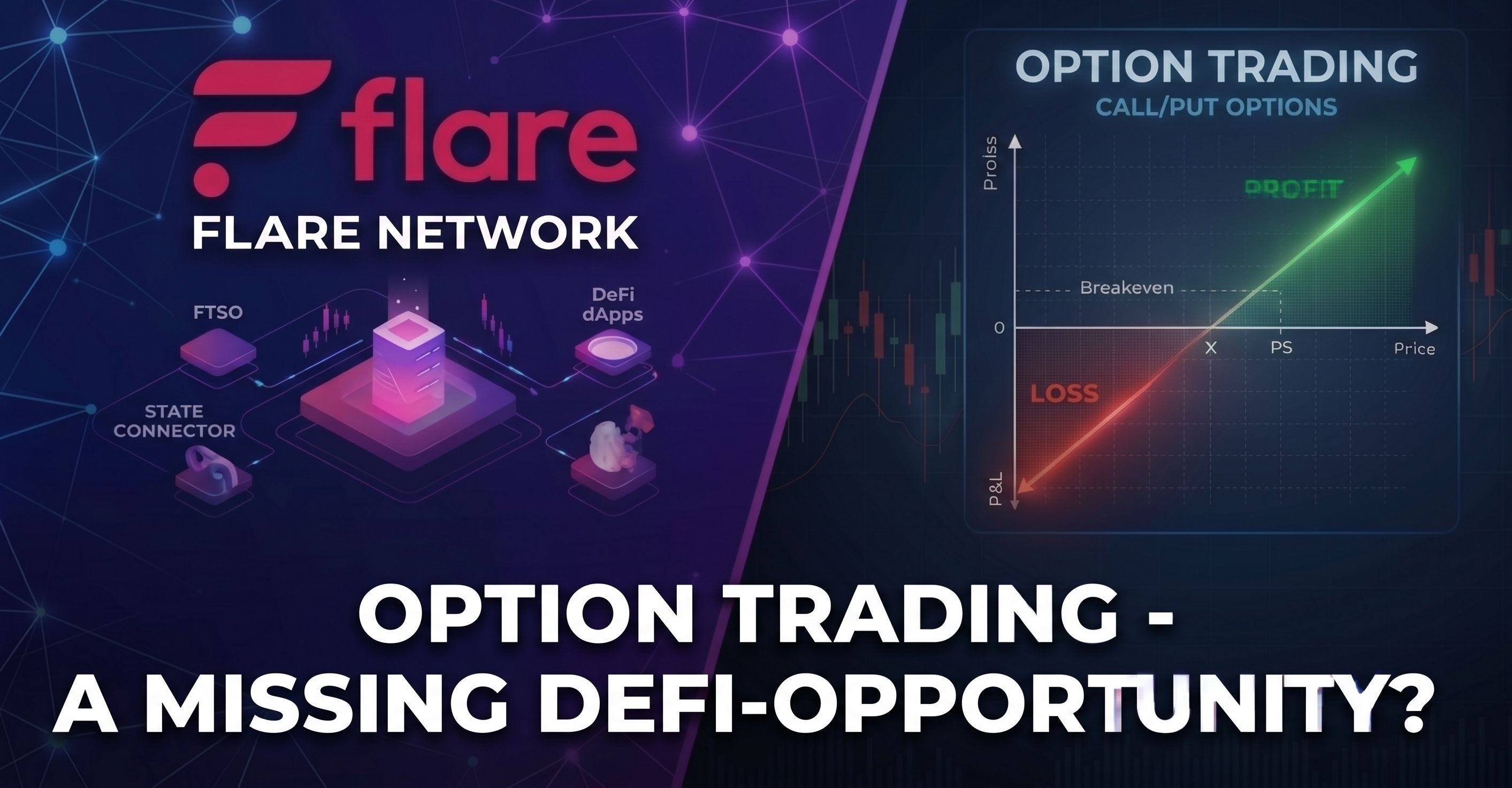
Flare has no native options market. The only venue for FXRP options runs on an external chain and gates access behind a quarter-million-dollar minimum.
Look at Rysk’s contact form. The footnote underneath the allocation field explicitly reads: “Minimum allocation size is $250K.”
For a retail holder, that line is a lockout. For a protocol builder, it is the loudest signal in crypto: an unserved market protected by an artificial moat. It is an unclaimed monopoly. Here is the blueprint for the team that wants to build the bypass and capture it.
The Structural Asymmetry
Covered calls on FXRP currently require external chains, bridging costs, cross-chain risk, and fragmented liquidity. Cash-secured puts do not exist at all. Every comparable ecosystem: Ethereum, Solana, Arbitrum, and Base, has massive on-chain options venues. Flare has a structural vacuum where that layer should be.
But the argument for building this on Flare is not just about filling a hole. It is about a structural asymmetry. Spot markets price exactly one variable: direction. You are long or you are short. Options price four dimensions at once: direction, time decay, implied volatility, and convexity. To price volatility on-chain without getting exploited, developers need high-frequency, manipulation-resistant oracles. Every options protocol on Ethereum bleeds capital paying for oracle updates.
Flare has the FTSO as a native, block-latency price oracle built into the network. It has FAssets bringing external collateral directly on-chain without centralized wrapping. A developer deploying an options AMM on Flare starts with zero oracle overhead and native access to idle FXRP collateral: 155M tokens today, a fraction of the 5B the ecosystem is aiming for. The infrastructure is lying on the table.
Without this primitive, token holders are restricted. They can hold. They can lend. They can stake. They can delegate. They cannot monetize volatility.
Lot size compounds the opportunity. An equity option is a standardized hundred-share contract, so a single position demands meaningful capital before the first premium clears. On-chain, a covered call writes against any fraction of the underlying. The minimum lot is whatever the contract allows, with gas as the only practical floor, not a convention inherited from the trading pit. That collapses the entry threshold from a quarter-million-dollar gate to pocket change, and expands the addressable market by an order of magnitude. The monopoly is not only the capital locked above the gate. It is everyone the gate was built to exclude.
The Architecture: Neutral Venue, Aggregated Flow
The point of an architecture proposal is to map the structure before a team writes the first line of Solidity.
The collateral question comes first, and it splits into two axes most venues fuse. The pricing yardstick is what the strike references: it has to be USD, because an asset priced against itself has no volatility surface. The settlement currency is what collateral and premium are denominated in, and that is the sovereignty lever. The default is USD-priced and USDT0-settled: collateral, strike, premium, and settlement in one intuitive unit. The second path, required from day one, is coin-settled: a USD strike, but collateral and premium in FXRP, no stablecoin held. Buyers and sellers self-select. The protocol provides the infrastructure, not the preference.
The matching layer borrows a pattern from Spectra. Each combination of underlying, yardstick, settlement currency, and maturity operates as an independent contract. One maturity per month per configuration keeps fragmentation in check while giving the market room to scale.
The Distribution: Solving the Builder’s Go-To-Market
Developers building DeFi usually die in the customer acquisition phase. This architecture solves that natively through a distribution layer: Curated Vaults.
Most retail users do not want to manage strikes and maturities. They want aggregated yield. A curator — a human team or an algorithmic agent — aggregates depositor capital and runs a defined strategy. Sentora and others are building exactly this category. The builder focuses entirely on secure infrastructure. The curators own the user relationship and bring the flow. You build the pipes. They bring the liquidity.
Where the Money Comes From
The venue earns from trading fees and spread capture.
There is a third asset the venue generates that must explicitly not be monetized: data. Implied-volatility surfaces and open-interest distributions are sold behind API tiers by traditional venues. This protocol must do the opposite. Free APIs, public dashboards, an indexable subgraph, and open websockets. Open data lowers the integration cost for structured-product builders. The data is the lure. The trading layer is the toll.
The Execution Gap: The Request for Proposal
Anyone can write the optimistic version of a whitepaper. The honest version lists how it dies. The full Request for Proposal documents eleven distinct failure modes. Here are the core four.
First: Buyer drought. Venues fail when everyone wants to collect premium and nobody wants to buy. Mitigation: Subsidize buyer fees early.
Second: Token reflexivity. If the protocol token is coupled to liquidity provision, a falling price widens spreads and kills volume. Mitigation: A stablecoin tranche that decouples spread depth from token price.
Third: Adverse selection. Liquidity providers get picked off by informed flow ahead of oracle updates. Mitigation: Strict FTSO update block-delay integrations.
Fourth: Curator blow-up. A bad vault strategy drains retail capital. Mitigation: Strict whitelisting of vault primitives.
A proposal that cannot be falsified is a wish. This is a blueprint.
The market gap is validated. The structural advantages in FTSO and FAssets cannot be replicated by wrapped EVM solutions. The only missing variable is the execution team.
This is an open Request for Proposal (RFP). I am looking for the developers, architects, liquidity providers, and curators ready to build the missing options layer on Flare. Two routes are on the table. Adapt an existing venue (a SparkDEX module on their V4 hooks, or a Lyra-style fork ported to FTSO and FAssets), or build greenfield.
The full RFP is public. Draft 12, open for review.
https://github.com/janus-watcher/rfp-options-flare-native
Read it, then break the assumptions. Tell me where the architecture fails. And if you have the technical capacity to build the category leader of Flare options, execute it. The $250,000 gate is not a law of nature. It gets drained by whoever moves first with the right structure.
- J.
Brilliant RFP. - Hello? Hugo? Anybody? Are you listening?