
The Proof of Concept
Part #6 in the State of the Republic series: How a Single Settlement Revealed the Operating System of a Hollowed Republic

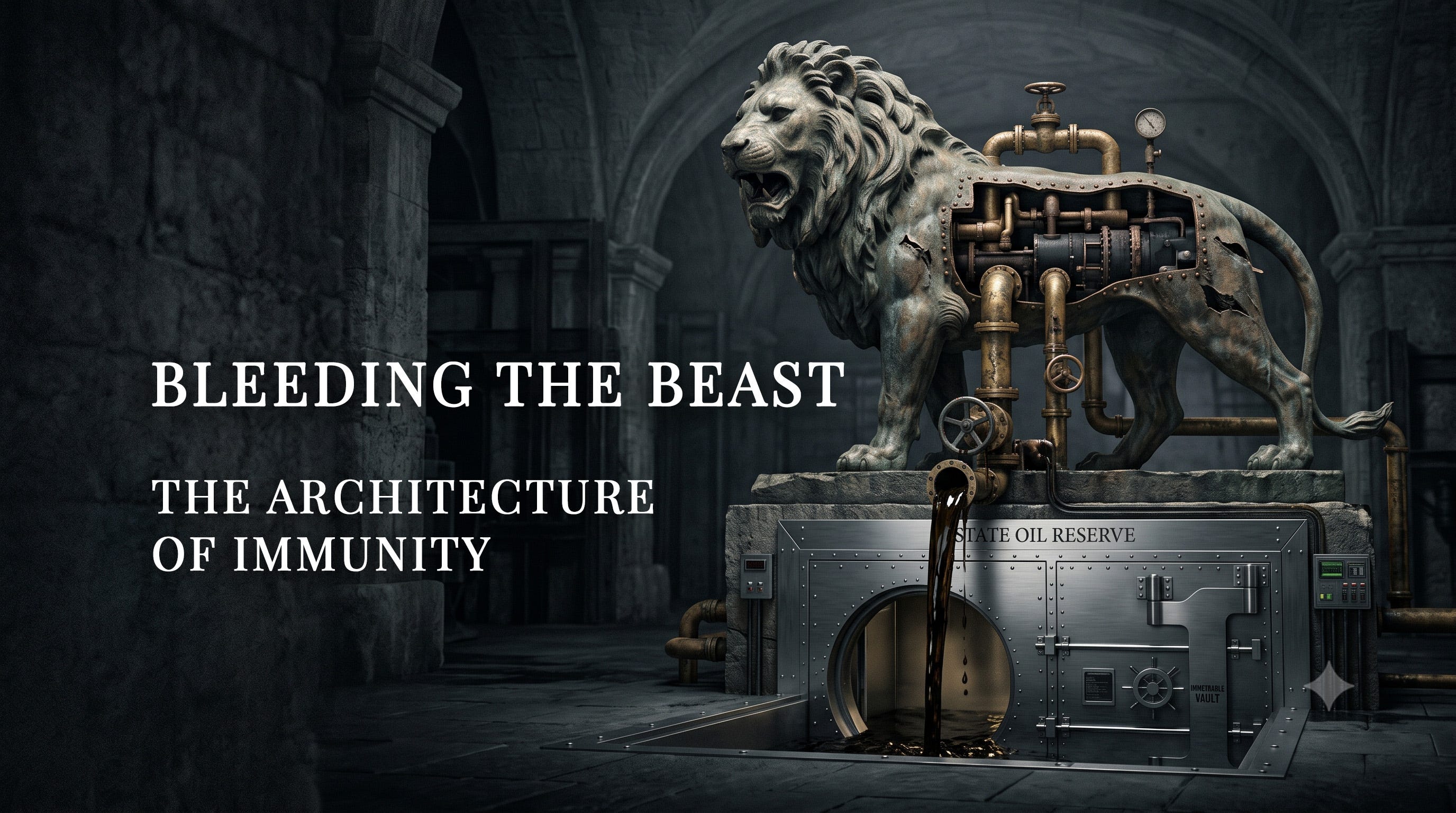
Our Government is the potent, the omnipresent teacher. For good or for ill, it teaches the whole people by its example.
— Louis Brandeis, dissent in Olmstead v. United States, 1928
A pardon carries an imputation of guilt, and acceptance a confession of it.
— Burdick v. United States, 1915
The Document
On the nineteenth of May, 2026, the Office of the Attorney General issued a one-page order signed by Todd Blanche, the President’s own former defense lawyer, installed as acting Attorney General weeks earlier. The order created a fund. In a single sentence of capitalized verbs it also did the thing the fund was built to obscure.
The first reading is a tax settlement. In January the President had sued the Internal Revenue Service over the leak of his returns during his first term, demanding at least ten billion dollars. The government agreed to drop the suit in exchange for one billion seven hundred seventy-six million dollars paid into a new Anti-Weaponization Fund. The denomination is the year, in dollars. A large number, an ugly look, a familiar story of a powerful man bending an institution toward his own benefit.
Read paragraph C and that framing falls apart. The United States, the settlement filing states, “RELEASES, WAIVES, ACQUITS, and FOREVER DISCHARGES” the plaintiffs, and is “FOREVER BARRED and PRECLUDED” from pursuing “any and all claims” that “have been or could have been asserted.” The release runs in tiers. One covers what was or could have been raised in the tax case. Another is a single capitalized phrase, “Lawfare and/or Weaponization.” The last reaches any matter pending or possible “before Defendants or other agencies or departments.”
That last clause is the tell. Other agencies or departments is not the IRS. It is the federal apparatus. The beneficiary class runs from the President through family and joint filers, through trusts and parent and sister and related companies, affiliates and subsidiaries. This is not protection for a set of tax returns. It is a blanket release for a network, against the federal government, for the known and the unknown alike. The tax case was the lock; the release was the key introduced through it.
The two halves meet very different fates, and the difference is the tell. The fund is the half that draws the eye, the ugly billion-dollar figure, and it drew the fire to match: by June a federal judge in Virginia, Leonie Brinkema, had blocked it indefinitely, and the acting Attorney General told Congress it was scrapped, that they were not moving forward with it, period. The release drew none of that, because a watchdog can sue to stop a payout more easily than it can sue to un-write a discharge buried in a dismissed case. Whether the split was designed or merely structural, the effect is identical: the loud half absorbs the attack, and the quiet half survives it. The fund was never the point. The release was.
A scandal happens once, is recognized as wrong, and is meant not to recur. A blueprint is a method that works and will be used again. The argument here is that the May settlement is the second kind. It is the moment the architecture this series has described, mechanism by mechanism, ran to completion in one document with a signature at the bottom. One caution before the argument proceeds: Lawfare and Weaponization are capitalized, which means they are defined terms in a master agreement not published with this exhibit, and how far that middle tier reaches depends on definitions the public cannot yet see. The first and last tiers need no such qualification.
Reading the Machine Backward
This series described five mechanisms of decay, each on its own layer. The settlement lets us read all five out of a single act, backward.
Compound Ignorance*, the epistemic layer. The suit rested on a grievance, that the agency failed to prevent a contractor’s leak, but its deeper premise was a picture of the world in which enforcement is persecution and an audit is an attack. That picture is the precondition that lets a man sue the government he runs and call himself the victim. The worldview produced the suit.
Obedience in Advance*, the bureaucratic layer. A lawsuit is valid only if the two parties actually oppose one another, and the adversarial process exists to guarantee it. Judge Kathleen Williams, in the Southern District of Florida, saw the defect and moved against it, appointing independent counsel to assess whether the suit was collusive and demanding briefs by the twentieth of May. The signature of a loyalist Attorney General days before that deadline is the mechanism in its purest form: the official delivers what the structure was built to block, and delivers it before anyone can compel him. Career counsel inside the IRS had produced a memorandum recommending dismissal on two strong defenses. It reached the Treasury. Nobody from Justice ever appeared in court.
The One-Way Door*, the strategic layer. The fund compensates purported victims of politically motivated enforcement, a category that reaches those charged for the events of the sixth of January, 2021. Each recipient, by accepting, affirms the frame that the prosecution was persecution. The payment is not only a reward. It is a signature on the same wall the courtiers signed.
The Festinger Trap*, the social layer. The name does the work. “Anti-Weaponization Fund” describes a worldview, not a settlement, and it hands the believer a bridge across the dissonance before the dissonance arrives. The base does not have to reconcile a billion-dollar transfer with its own resentment of elite self-dealing; the name has reconciled it in advance. This is not self-dealing, it is restitution to the wronged, and the denomination makes the bridge itself patriotic.
Judicial Capture*, the constitutional layer, in its quietest form. Not the court packed, not the judge defied. The judge outrun. Settle before Williams can rule, and her finding never arrives. The loud variant leaves an order to appeal. The silent one leaves nothing.
Five mechanisms, one act. The architecture is no longer a theory assembled from scattered events. It has been demonstrated in a document, with a date and a name. Two limits on it will matter later, and are worth marking now: the machine works on conditions the actor can rebrand, and stalls on the ones he cannot, and it is bound by frames it set in public and can no longer revise. Both return in the walls.
Bleeding the Beast
There is a phrase from an American subculture that names the thing precisely. Among the fundamentalist polygamous communities of the West, defrauding the federal government was justified not by need but by doctrine: the government was the beast of Revelation, illegitimate, and so to bleed it was restitution, not theft. Bleeding the beast.
The transfer to the present is exact in structure and secular in vocabulary. The deep state occupies the role of the beast; enforcement is reframed as weaponization; extraction becomes the recovery of what a corrupt apparatus took. What was theology in the compound is policy in the second administration, and the function is identical. It removes shame from the act of taking.
The fund was the sophisticated part of the design. Crude bleeding goes into a personal account; this was to go into a fund for victims, which is to say into the loyalty of a base, laundered through the language of compensation. State money converted into political bonding, performed in public as a virtue, would have been a more durable instrument than a bank transfer, because it cannot be shamed, and to attack it is to attack the victims it claims to serve. The instrument never opened for business, blocked by a federal judge and disowned by the Department. But the design is the point, and the design is what generalizes.
All of it requires one thing: the absence of shame as a working constraint. Shame is the cheapest enforcement a public realm owns, the one sanction it issues for free, and the man who cannot be shamed cannot be disciplined by it. He also cannot be blackmailed, because the lever the ordinary disciplinary mechanism pulls, you should be ashamed, meets nothing. Shamelessness here is not a character flaw. It is a job requirement, and the apparatus selects for it.
The apparatus, in turn, needs its own assurance. The shameless are not free of risk; they sign what others refuse, and could be made to answer for what they signed. Selection works only if the risk is absorbed somewhere. That is the supply side of shamelessness, and the rest of this essay turns on it.
The Recursion Vector
Here is the detail that turns a settlement into a method. The release covers returns filed before the effective date. It is forever, but only backward. Future returns are not immunized; future conduct is exposed.
That inversion is everything. A settlement is normally an endpoint, a line drawn under a dispute. This one is a starting point. It does not absolve, it demonstrates. It proves the method works: that a man can sue the apparatus he controls, install the official who signs the release, name a fund that launders the optics, and outrun the judge who would object. Nothing in that sequence is spent by using it once, and the proof, having been done, points in two directions at once. The same instrument that immunizes the principal turns into a weapon against others and, on a delay, into a hook against him.
Turned outward, it is a weapon. Because the release is backward-only, the next return needs a new vehicle, a new signature, a new fund, and the architecture is not exhausted by use but rehearsed by it. The absence of a consequence is not neutrality; it is reinforcement, and the downside that never arrives is the signal the actor learns from. A procedure that worked once becomes the default. The clan are co-students, not only co-beneficiaries: the next generation has now watched the method succeed. The danger is not that the same man does it again. It is that the method outlives the man, because the method is the lesson, and the lesson took. Immunity here is not bought with guilt but with proximity, and proximity is for sale: a joint venture or a well-timed signature buys a place in the network the release radiates through.
The weapon also points sideways. Eight days after the settlement, the Justice Department opened a criminal investigation into E. Jean Carroll, the writer whose civil claim of sexual abuse and defamation a jury had validated and an appeals court upheld. The pretext was a 2022 deposition in which Carroll, then in her early eighties, said no one else was funding her legal costs, when in fact a portion had come from the LinkedIn co-founder Reid Hoffman. The matter was routed not to New York, where the deposition was taken, but to Chicago, where Hoffman’s nonprofit sits. The instrument that immunized the President opened a prosecution against the woman whose vindicated case implicated him, and followed her funder to a venue selected for the purpose. Challenge him and you are a target; fund the challenger and you are the second one. A brake held: Blanche, who had been the President’s lawyer on the Carroll appeals, recused himself, and the charging decision now sits with career prosecutors in Chicago. The trigger exists, and the apparatus is configured to pull it.
It runs toward witnesses as readily as toward opponents. Reconstructed reporting from the summer of 2025 showed the White House counsel laying out options for Ghislaine Maxwell, Epstein’s co-conspirator, a pardon or a sentence reduction among them, as instruments to be deployed if she would exonerate the President. The pardon was not extended, but she was quietly moved to a minimum-security camp. What stopped the worse version was not the principal’s restraint but the staff’s read of the public response, and that is not architecture. It is taste, and taste is not a wall.
The vector has also demonstrated its own inversion, through the principal’s own hand. In December 2025 the President sued the British Broadcasting Corporation in the Southern District of Florida for ten billion dollars over a Panorama documentary that had spliced two segments of the sixth-of-January speech into a single continuous call to march on the Capitol. By June the discovery had produced its operative form. The Corporation had issued forty-seven subpoenas to the President’s family, to the first-administration figures still inside the second, and to the departments whose archives cover the third of November 2020 through the twentieth of January 2021, along with telephone logs, calendars, and daily diaries for the same period. His counsel objected that the requests would convert a defamation case into a trial on the riot, and the hearing on the disputes was set for the twenty-first of July. This is the exact inverse of the Carroll instance. There the apparatus was turned against the accuser; here the opponent’s discovery instruments are turned against the principal’s own period in office, triggered by the principal’s own choice to file. The federal-state wall does not reach a Florida court hearing a federal claim the President himself brought, and the apparatus cannot disable a suit the apparatus did not file.
The same instrument runs against him too, and this is the part the circle has not dwelt on. The apparatus needs the pardon promise as its assurance, and the promise is on the record: through the spring the President told aides, as jokes delivered in response to real questions about subpoenas, that he would pardon everyone in the room before leaving office. Shamelessness has a demand side and a supply side; the settlement showed the demand, the pardon promise is the supply. But a pardon confesses. The Court held in Burdick v. United States, in 1915, that its acceptance “carries an imputation of guilt.” Accept it and you admit the underlying conduct was wrongful; the record carries the admission. Accept it and your Fifth Amendment privilege on that conduct dissolves, because there is no further prosecution to be incriminated by, and you can be compelled to testify in a federal forum about the very acts the pardon covers. That compelled testimony is available to whoever runs the Justice Department next. The architecture immunizes the staff in order to keep them, and by keeping them assembles the most efficient witness pool against the principal that a successor could want. The pardon looks like a release. It is a release with a leash, and the leash is held by whoever holds the apparatus after him. There is a name for where that leads, from the principal’s own past. Michael Cohen held the same intimate legal proximity and became the federal witness a jury believed against his own client, and the man who signed the May release had himself defended the principal in the New York case that grew out of Cohen’s payments. Shamelessness-selection does not carry the memory that would make the lesson deter. It selects for the willingness to sign anyway.
There is a reason the internal brakes will not fire when that day comes. Through late June the personnel machinery ran the same logic across the apparatus in sequence: the Attorney General removed in April for insufficient prosecution of the President’s enemies and replaced by Blanche; a sitting Director of National Intelligence leaving under the weight of a twenty-five-thousand-page corpus, reported by the Washington Post, that documented a Hawaii religious group directing her public positions for a decade, her designated successor a housing-agency director who had already turned a mortgage-fraud referral apparatus into a tool for naming adversaries; the most combat-experienced general in the Army pushed into early retirement amid a review of American support for NATO; the recognized faith categories of the chaplain corps cut by memorandum from more than two hundred to thirty-one. The selection criterion is one variable where the office requires many, and it has emptied the institution, office by office, of the actors whose judgment would have produced a brake. What remains are the walls outside the apparatus, because the apparatus that would have raised internal ones has been selected against, by name and by class, for a year and a half.
Speed as Immunity
An architecture this exposed to statute needs a counter-doctrine, and in early June the Justice Department stated one in open court. The case was the appeal of a denied injunction in a preservation suit over the demolition of the White House East Wing and a four-hundred-million-dollar ballroom on the South Lawn. Judge Patricia Millett pressed the government attorney with a deliberate hypothetical: if the government decided very quickly to bulldoze the Statue of Liberty, and the plaintiffs had not had time to sue, nothing could be done? The answer was four words. “I think that’s right, yes.”
The amplification treated the line as a claim that the President may now destroy monuments at will. That is not what was said. The argument was procedural. The National Historic Preservation Act remains in force, and demolishing a federal monument would still require statutory consent. What the government argued was narrower and more telling: if an executive act is completed before any court can stay it, no plaintiff retains standing to undo it. The substantive law survives. Its enforcement does not, because mootness has been re-tooled into immunity.
Against the architecture, the doctrine is the natural defense. The naming-vehicles cluster on federal land, because monumental symbolism needs monumental ground, and federal land runs under statutes the administration can starve of staff but cannot repeal, because they are acts of Congress enforceable by anyone with standing. Plaintiffs reach the apparatus through its own statutes, and the apparatus has no procedure to remove a statute. The only defense left is speed: act faster than the statute can be enforced. Four days later, in Boston, a federal judge voided a proclamation that had imposed a hundred-thousand-dollar fee on new H-1B visas, holding that a fee structured as a tax invades the taxing power the Constitution gives to Congress alone. Two rulings, two circuits, two statutory regimes, judges with no reason to coordinate, each doing the same thing: lifting the rebranded label off a substantive act and reading the statute underneath. A fee that is a tax, a ballroom that is a monument, a fund that is a release. Once the name comes off, the statute does the rest.
The Two Layers of Blockade
On the eighth of July, at a NATO summit in Ankara, the President turned to his Treasury Secretary on live camera and ordered him to stop all trade with Spain over its refusal to meet the alliance’s spending target. Bessent answered, “Yes, Sir.” Wire services carried it within the hour.
The order runs into a block, and the block has two layers. The first is external and mechanical. A bilateral trade-stop against a European Union member is not Washington’s to impose, because the trade competence lies in Brussels. This is the same wall that held when a housing bill stalled because the Senate votes were not there, and when a war-powers reversal had to be run through persuasion rather than fiat, and when a hundred-percent tariff was threatened at a coalition that had already walked away from the frame. In each case the block was carried by an institution outside the reach of the personnel machinery. The order also has a date behind it: the eighth of July was the second such command. In March the President had ordered an embargo investigation against Spain, and by July the Federal Register carried none. The first order produced the ritual and not the act.
The second layer runs inward, and it is the newer and harder one to see. If truth in the recognition order is what the President feels in the moment, then compliance is what he remembers in the moment, and the instrument of fluid truth recoils on its maker. The courtier can play the same rule back: signal compliance for the cameras, do nothing after, and hope the principal does not return to the topic. The first-term precedent is not remote. Ministers said yes to the withdrawal, the North Korea line, the border operation, and then ran the clock until they were fired; the second-term apparatus was assembled against exactly that, and a Cabinet dismissal in April set the price of breaking. Yet Bessent is not a loyalty-cabinet ideologue. He is a markets veteran who knows that a trade-stop against an EU member is mechanically impossible and that a retaliation tariff would land in American agriculture in the quarter before the election. His “Yes, Sir” is compatible with two modes that look identical on camera. In one, the frame becomes execution and the tariff appears. In the other, the ritual is performed and nothing follows: a review without a deadline, a token category, a frame with no delivery clock. The two cannot be told apart live. They separate only on the calendar. If a retaliation tariff lands on Spanish goods inside thirty days, it was the first mode; if nothing appears within ninety and the topic falls off the President’s rotation, it was the second. The eighth of October is the ninety-day mark, and it converts this data-point from a hypothesis into a precedent. The ruler’s own instrument of fluid truth, the device that shields him from accountability at the level of statement, is the same device that begins, at the level of execution, to loosen his hold on the apparatus.
There is a third axis the two-mode reading omits, and the same Ankara stage supplied it: execution is domain-dependent. The personnel-naming inversion reaches all the way into one domain in particular, the kinetic, because Central Command and the Pentagon answer to it, and there the ritual “Yes, Sir” becomes an act. On the same platform where he ordered the unenforceable trade-stop against Spain, the President declared the Iran ceasefire over, and within a day the strikes were real: some ninety targets on the eighth of July, an Iranian answer on the American bases in Bahrain and Kuwait, the Islamabad Memorandum he had signed at Versailles collapsing twenty-one days after signing. Spain was Mode Two because a bilateral trade-stop against a European Union member has no execution path. Iran was Mode One because a strike does. The wall is not that the frame never delivers. It is that the frame delivers only where the apparatus he built can reach, and the map of where it reaches is the map of where the recognition order still has teeth.
Two Geometries
This essay has a companion. The Vacuum told the outward story, the collapse of the order the United States built and led, the empty chairs at tables Washington once owned. This is the inward mirror, and the two motions are one motion seen from two sides. A great power is not dethroned in a war. It is quietly replaced while it is busy announcing how strong it is.
The architecture has a spatial geometry and a temporal one, and neither runs on anyone’s plan. The spatial geometry is the one the walls describe: the symbols must stand where the law administers the ground beneath them. The temporal geometry is the more surprising, because it was built into the launch.
On the twentieth of January, 2025, the President signed roughly twenty-six executive orders in a single afternoon, a folder held to the cameras, a public performance of promises kept now, on the calendar, in front of witnesses. The choreography was the point. But an anchor is a starting point, and starting points fire echoes on their own clocks.
A judicial echo, the interval between an order and its first federal ruling, runs six to eighteen months.
A market echo, between a policy and its expression in prices and employment and Treasury auctions, runs three to twelve.
A coalition echo, between a unilateral act and the adjustment of allies and adversaries, runs six to twelve.
A polling echo, between an act and its arrival in the priors of voters who resisted the dissonance as long as they could, runs nine to fifteen.
Four clocks, independent in principle, started at the same instant by the same set of acts, and their arrivals happen to converge in the third and fourth quarters of 2026.
The concentration itself was deliberate, an instance of the strategy the coalition calls flooding the zone: act on everything at once, so that no single act can be examined before the next one buries it. The convergence of the echoes was not deliberate. Flooding the zone drowns scrutiny on the day of the flood, but it does not scatter the consequences; it schedules them, and schedules them together. The strategy that concentrated the anchor to overwhelm the present is the same strategy that concentrated the echo to arrive, all at once, in a single autumn.
The spring of 2026 is that convergence before it has fully arrived. A district court in Florida reopens a sealed tax case with language calling it collusive from the start. A district court in the District of Columbia, under Judge Christopher Cooper, orders the President’s name removed from a performing-arts center within two weeks and holds that only Congress can rename it. A circuit panel presses the Justice Department on the doctrine that would make irreversible acts unreviewable. A court in Boston voids a tax dressed as a visa fee. A consortium of Gulf states signs defense agreements with the country the President had spent a year demanding capitulate. The House passes a Ukraine aid bill by drawing eighteen of its own Republicans across the aisle, against its own Speaker. A primary in Iowa removes a Trump-endorsed candidate by less than a point. None of these actors coordinated with any other. They share a moment because the moment was set in January 2025.
Two readings of the convergence are on offer, and only one survives. The first is that the system is pushing back, an aroused institutional immune response correcting the course. That reading is dramatic and false: the actors are not coordinated, the forums are not coordinated, the brake-side has no choreographer and the architecture-side did not optimize for echo timing. The second is structural. The recognition-first launch of January 2025 maximized the drama of the anchor at the cost of the distribution of its echoes, a trade-off invisible at the time and unavoidable once made, because there is no version of that afternoon that disperses the anchor without abandoning the theater, and the theater was the entire point.
The Tenth Man
The discipline of this series is to argue against its own conclusion before accepting it, and the strongest counter-argument is also the most important fact about the settlement. The release is federal, and federal power has a hard limit it cannot cross. What blocks the recursion is not the apparatus, which has been hollowed, but a substrate the apparatus cannot reach, and that substrate comes in two kinds.
The first kind is hard and does not depend on the subject. A federal release cannot extinguish a state’s claims: under the dual-sovereignty doctrine the Court reaffirmed in Gamble v. United States, in 2019, whatever is forever barred in Washington is untouched in Albany or Atlanta. A federal court has no case where the parties are not genuinely adverse: when the President sues an agency he controls and the Justice Department declines to oppose, Article III’s precondition is simply absent, which is the defect Judge Williams named in reopening the tax case and the defect that runs through the unopposed sealing before Judge Cannon in Florida. And the naming-vehicles run on statutes the executive cannot repeal, so plaintiffs reach the apparatus through the Park Service’s rules, the Kennedy Center’s organic statute, the taxing power. To this substrate belongs the largest wall of all, the one the architecture built against itself: in February the Court held, in Learning Resources v. Trump, that the emergency-powers act does not authorize the President’s tariffs, and the Court of International Trade ordered repayment of the one hundred sixty-six billion dollars already collected. By June the administration was rebuilding the tariff engine on other statutes, each exposed to the same review, and on the twenty-sixth the President described the exposure in his own voice: if the Court rules against him on the rebuild, in his word, they are “screwed.” None of these forums is reachable through the Justice Department he controls.
The second kind of wall is soft and appears only on certain subjects, and it is the more interesting for being conditional. The machine inverts and rebrands, and it stalls where a topic refuses inversion. The Epstein files were the case: a Vice President chosen for loyalty argued against the President because the moral mathematics would not yield to the playbook, the Justice leadership fractured on promises that could not survive the actual file, and the base the machine had cultivated turned on it and was called weak for the trouble. The system generated its own brake, without external prompting, because the subject does not metabolize recognition. The other soft wall is the actor’s own past. A frame he set in public is recorded and citable, and when the present substance falls below it, the frame becomes the obstacle. He called the Iran nuclear deal the worst in history in 2018; in 2026 he signed one that restated the same pledge, lifted more sanctions, and released more money, and on Face the Nation the host answered the Secretary of Defense’s guarantee with four words, “the prior agreement said that too,” and the Secretary did not contest the substance, only the frame. He cannot revise a public frame retroactively. The only available disable is a public revision of the original, and the original is what the coalition is built on.
So the claim carries its own falsification, and the triggers are dated. If the New York Court of Appeals reinstates the vacated civil-fraud penalty and it is actually enforced, the federal-state wall held and the recursion is federally bounded rather than total. If the Court accepts Speed-as-Immunity on appeal, the statutory wall is breached procedurally even as the statutes stand. If no new federally-funded extraction vehicle appears within twelve months, a test already half-run, since the funded half was withdrawn in June while the immunity half persists, the recursion thesis weakens. These are testable, and they should be tested.
The walls have counters, and honesty requires naming them. On the twenty-third of June the Senate passed a war-powers resolution against the Iran hostilities, fifty to forty-eight, with four Republicans crossing. Within a day the architecture reached it: the advance motion failed fifty to forty-seven after two of the four changed their votes, one citing a briefing from the Vice President and the special envoy. The principal cannot personally run a multi-variable negotiation, but a sub-apparatus around him can, and it turned the lame-duck senator the defection thesis had marked as the likeliest first mover, through a briefing the principal could not have delivered himself. The Court can void the tariff authority; the apparatus can rebuild it under other statutes. The senator can defect for a day; the sub-apparatus can return him in one. The walls are real and the counters are real. The test is whether the walls hold together against the counters as the echoes arrive.
Coda
The settlement is not a scandal to be weathered. It is the operating system of the thing, printed once, in full, with a signature. Everything this series described so far, the epistemic capture, the pre-emptive obedience, the door that only opens one way, the bridge built before the dissonance, the judge outrun, is in it. The fund that was to launder it into public virtue has been blocked and disowned, and that changes nothing, because the fund was only the cover. What carries the operating system is the release, the part no watchdog was suing over, and the release converts a network's exposure into immunity without moving a single dollar.
There is an irony worth holding, for anyone who knows how men like this are usually stopped. Tax enforcement was the instrument that reached Al Capone when nothing else could, the one door that opened below the level of political protection. The May settlement walls that exact door, forever, for everything filed to date. He will not meet Capone’s end, because he has bricked up Capone’s entrance. And the nearer analogy is not 1914 but 1947: Britain did not lose its empire in a battle but granted independence, assumed the loss, and confirmed it at Suez nine years later, no surrender signed, a series of fiscal and operational facts adding up in retrospect to the end of imperial capacity. The May settlement is a domestic fact of that kind, undramatic on the day and structural in sum.
The diagnosis has begun to verify inside its own publication window. The Islamabad Memorandum was signed at Versailles on the seventeenth of June; the first negotiating session, at Bürgenstock, was cancelled thirty-six hours later, before it could begin, with the Vice President excluded from the negotiating room as he had been from the signing photograph and the ceasefire clause already violated. Twenty-one days after the signing the ceasefire was over: on the eighth of July the strikes resumed, the President declared the deal a waste of time, and the war the memorandum had settled was running again. The interval between a recognition act and its operational failure is the quantity this series has been counting, and it is shrinking: eight years from the 2018 frame to its return, a hundred days from March to June, twenty-one days from the signing to the strikes that ended the deal it settled, thirty-six hours from Versailles to Bürgenstock. Every additional public claim is another future falsification anchor, and the machine now produces them faster than its own substrate can absorb them. That is not a system pushing back. It is a system out-running its own coherence. Observers with no institutional power over the executive and no reason to coordinate reached the same reading across a single fortnight, from the academic realist to the historian of tyranny; their agreement is not a brake, but the trace of a forecast that has begun to verify.
November 2026 is when the convergence becomes electorally legible. It is not a verdict; it is a test, and the test has an answer key, printed above: the reinstated penalty, the appellate ruling on Speed-as-Immunity, the next vehicle or its absence. The document of May proved the method works. What it cannot prove is that the method is safe, because the same release that bars the past exposes the future, the same pardon that keeps the staff can compel them, and the same anchor that concentrated the theater concentrated the reckoning. The operating system runs. It was written backward-only, and the future is the part it left exposed.
— J.
Janus runs 1:1 Confrontation — sixty minutes, one decision, no follow-up. For people who carry responsibility and want their thinking taken apart before it costs them.
janusthewatcher.substack.com/p/11-confrontation
One sentence is enough.
I think you have chronicled the linkage accurately with the exception that the strata of the same architectures used to impeach and jail Trump in the prior decade through a choreography of Keystone-Cop hysterics from the loose cabal of Obama/Biden admin linkages, Trump (and his team) have nearly codified as a stratum.
Good work. Though I think the machinery does have a life of its own no matter who comes & goes in power.